So, you’ve decided to learn Japanese. Maybe it was an anime binge, a trip to Tokyo, or just the thrill of tackling a language that uses three writing systems (because one clearly isn’t enough). Whatever brought you here, welcome — and let’s talk about the thing that trips up almost every beginner: Japanese sentence structure.
Here’s the good news: Japanese grammar structure is actually more logical and consistent than you might expect. Once you understand a handful of rules, you’ll be building sentences faster than you can say sumimasen. Let’s break it all down.
Every language has a default way of arranging words. In English, we follow the Subject – Verb – Object (SVO) order: “I eat sushi.” Simple, familiar, done.
Japanese flips the script. Japanese follows a Subject-Object-Verb (SOV) sentence structure. Unlike English (SVO), the verb always comes last. For example: Watashi wa sushi wo taberu = “I sushi eat.” This applies to basic, negative, and question sentences alike. In short, this means the verb always comes at the end of the sentence. Always. No exceptions. (Okay, very few exceptions — and you won’t run into them for a while.)
If you’re wondering how Japanese sentences are structured compared to what you already know, think of it this way: in English you say “I eat sushi,” but in Japanese you say “I sushi eat.” The meaning is the same; the word order is just rearranged.
Let’s look at the Japanese sentence structure vs English side by side to make this click:
私は寿司を食べます。
Watashi wa sushi wo tabemasu.
"I eat sushi."
In English: I (subject) + eat (verb) + sushi (object).
In Japanese: 私は / Watashi wa (subject) + 寿司を / sushi wo (object) + 食べます / tabemasu (verb).
That's the core pattern of every basic Japanese sentence structure. The verb always comes last — not because it's shy, but because it's the main event. Think of it as the grand finale of every sentence, the cherry on top that ties the whole thing together.
Now that you know the big-picture word order, let’s look at the building blocks of Japanese grammar. There are four things every beginner needs to understand: the SOV pattern, particles, negatives, and questions.
We’ve already met the SOV pattern. Let’s reinforce it with a few more Japanese sentence structure examples:
田中さんは本を読みます。
Tanaka-san wa hon wo yomimasu.
"Tanaka reads a book."
猫は魚を食べます。
Neko wa sakana wo tabemasu.
"The cat eats fish."
学生は日本語を勉強します。
Gakusei wa nihongo wo benkyou shimasu.
"The student studies Japanese."
Did you notice the pattern? Subject first, object in the middle, verb at the end. Every. Single. Time. This consistency is actually one of the things that makes Japanese sentence structure easier to learn than you’d think — once you internalize the order, forming new sentences becomes almost automatic.
You might have noticed those tiny words — は (wa), を (wo/o), に (ni), で (de), へ (e) — sprinkled throughout the examples above. Those are particles, and they are the backbone of Japanese grammar structure.
Unlike English, which relies heavily on word order to show meaning, Japanese uses particles to tell you the role of each word in a sentence. Move the words around, and as long as the particles are attached correctly and the verb stays at the end, the sentence still makes sense.
Here’s a quick cheat sheet:
は (wa) — marks the topic of the sentence (“As for...”)
を (wo/o) — marks the direct object (the thing being acted on)
が (ga) — marks the subject (who or what does the action)
に (ni) — indicates direction, location, or time (“at,” “to,” “on”)
で (de) — indicates where an action takes place or the means of doing something
For example:
私はカフェでコーヒーを飲みます。
Watashi wa kafe de kōhī wo nomimasu.
"I drink coffee at a café."
See how で (de) tells you where the drinking happens, and を (wo) tells you what is being drunk? Particles do the heavy lifting so you don’t have to memorize rigid word positions. Once you've got particles down, you'll be ready to start using them in real conversations — check out these Japanese phrases for travel to put your skills to work.
Making a sentence negative in Japanese is refreshingly straightforward. You change the verb ending. That's it. No extra "do not" helper words, no rearranging the structure of the sentence.
In polite speech, switch from -masu to -masen. This is one of the most common forms of Japanese verb conjugation you'll encounter:
私は寿司を食べません。 Watashi wa sushi wo tabemasen. "I don't eat sushi." (polite)
For casual speech, swap the -u ending of the verb for -anai:
私は寿司を食べない。 Watashi wa sushi wo tabenai. "I don't eat sushi." (casual)
The sentence structure stays exactly the same: Subject – Object – Verb. The only thing that changes is the verb's tail. Understanding Japanese conjugation like this early on will save you a lot of confusion later.
If negative sentences are easy, questions are even easier. In most cases, you simply add the particle か (ka) to the end of a statement:
田中さんは寿司を食べますか?
Tanaka-san wa sushi wo tabemasu ka?
"Does Tanaka eat sushi?"
That’s it. You took a regular sentence, added か, and now it’s a question. In casual Japanese, you can even skip the か entirely and just raise your intonation at the end — exactly like English speakers sometimes do. (“You like sushi?”)

Theory is great, but nothing beats seeing real sentences in action. Let’s walk through simple and complex examples, and then compare Japanese sentence structure vs English in a handy table.
コーヒーを飲みますか。
Kōhī wo nomimasu ka.
"Do you drink coffee?"
彼は肉を食べません。
Kare wa niku wo tabemasen.
"He doesn’t eat meat."
私はテレビを見ます。
Watashi wa terebi wo mimasu.
"I watch TV."
These Japanese verbs — 飲みます (nomimasu, to drink), 食べます (tabemasu, to eat), 見ます (mimasu, to watch) — all sit at the end, right where they belong.
Once you’re comfortable with the basics, you can start chaining ideas together. Japanese uses conjunctions like から (kara) meaning “because” and が (ga) meaning “but” to connect clauses:
疲れていますから、ねます。
Tsukarete imasu kara, nemasu.
"I’ll sleep, because I’m tired."
日本語は難しいですが、おもしろいです。
Nihongo wa muzukashii desu ga, omoshiroi desu.
"Japanese is difficult, but interesting."
Notice that even in longer sentences, each clause still follows the SOV rule internally. The Japanese grammar structure doesn’t bend — it just stacks.
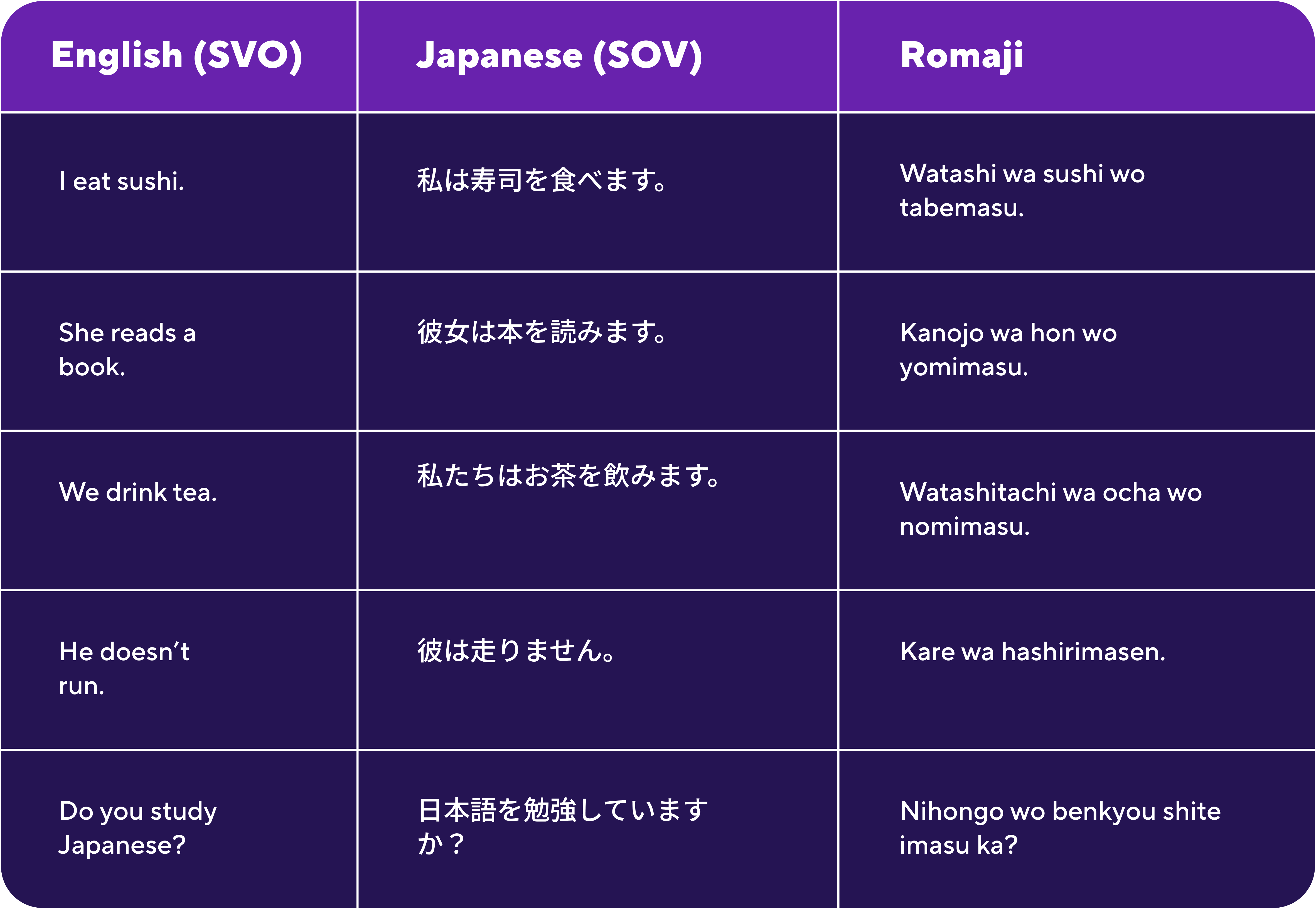
Here’s a quick Japanese sentence structure vs English comparison to see the differences at a glance:
Learning Japanese grammar is a journey, and everybody stumbles in the same places. Here are the classics:
1. Putting the verb in the middle. Your English-speaking brain will want to say “I eat sushi” in that exact order. Resist the urge. In Japanese, the verb goes last. Tattoo it on your brain (or just keep practicing).
2. Mixing up particles. Dropping a particle here and there is actually fine — even native speakers do it in casual conversation. The real trouble starts when you swap one particle for another, because a single particle can carry multiple meanings depending on context. For example, mixing up から (kara) meaning "from" and まで (made) meaning "until" is a classic beginner trap. Say you want to tell someone "I work from 9 o'clock" — that's 9時から働きます (kuji kara hatarakimasu). But if you accidentally use まで instead、 9時まで働きます means "I work until 9 o'clock" — a completely different schedule. Same words, one tiny particle swap, and suddenly you've flipped your entire workday around. Particles are small, but they steer the whole sentence.
3. Mixing up は (wa) and が (ga). This is the particle confusion that haunts learners for years. In short: は marks the topic (what you’re talking about), while が marks the subject (who or what does the action). They overlap sometimes, which is why it feels confusing. Don’t worry — native speakers know exactly what you mean even if you mix them up.
4. Over-conjugating verbs. Japanese verb conjugation follows clear patterns, but beginners sometimes try to apply rules from one verb group to another. The key: learn which group a verb belongs to (Group 1 / 五段, Group 2 / 一段, or Irregular) before conjugating.
5. Translating word-for-word from English. English and Japanese think about sentences differently. Instead of translating, try to think in the SOV pattern. It feels weird at first, then it clicks.

Understanding the rules is step one. Making them second nature is step two. Here’s how to get there:
Start with short sentences. Don’t jump into complex clauses on day one. Master “Subject + Object + Verb” with basic Japanese verbs before adding conjunctions and extra particles.
Drill particles separately. Spend a dedicated practice session just on は, を, に, で, and が. Knowing which particle to use is half the battle of Japanese grammar.
Practice Japanese conjugation out loud. Conjugation tables are useful, but saying the forms out loud builds muscle memory. Go from dictionary form to negative, past, te-form, and back again.
Use flashcards and spaced repetition. Pair each vocab word with an example sentence so you learn words in context, not in isolation.
Immerse yourself. Watch Japanese media with subtitles and listen for the verb at the end of each sentence. Once you start hearing the SOV pattern in real speech, you’ll know it’s sinking in. Want a full roadmap beyond grammar? Here's our guide on how to learn Japanese from scratch.

If reading about Japanese sentence structure has you pumped to start building real sentences, Drops is ready when you are. Our brand-new Japanese grammar modules take everything in this guide — SOV order, particles, Japanese verb conjugation, negatives, questions — and turn it into bite-sized, visual lessons you can practice in just five minutes a day.
No textbook walls of text. No rote drills that put you to sleep. Just clear, beautifully illustrated exercises that make Japanese grammar structure feel approachable and — dare we say — fun.
Ready to go from reading about Japanese to actually speaking it? Start learning Japanese with Drops and see how far five minutes can take you.


"Love my fun language learning and practice with daily Drops sessions, and monthly Challenges to participate in, and quiz mode to test contextual learning - brilliant! So much thought, consideration and inclusivity has gone into the design and function of this app, I can't praise it highly enough."
"Great little learning app! I've learned at least 5-10 new words in Spanish in my first 5 minutes. Easy to pick up and thorough."
"Great language learning app! It helps you get daily words done in a short amount of time. I would highly recommend using drops to learn whatever language you want to learn."
"What an amazing app! I’ve tried several apps for language learning and I cannot recommend Drops enough. I don’t know how a short Drops session can teach me as much as 1 hour+ of focused use of other apps, it’s like magic."
"Amazing language learning tool. Excellent app for increasing vocabulary in your foreign language of choice. Useful for beginner, intermediate, and advanced learners. The repetition of the words makes them much easier to remember, and without the hassle of making your own flash cards. I have used Drops for two years now and have seen great results."
"Very engaging way of learning Yoruba in a stimulating way. Will be using to learn myself and to teach my child!"
"Less than a week in but using this alone with the popular one babbel working on German. When using just one app I got bored, babbel is not as fun. So using both at once actually let's my adhd do its thing but I still focused since I can switch easily between both apps and work in different areas. Also I like the quick little sessions makes me feel like I actually did something."
"So engaging. I speak Spanish well, but often forget words in conversation that I know I should know. This game is fun and quickly brings back vocabulary I may have put in the back of my brain after not using it for awhile. Case in point: I spent 11 years in construction, then went back to teaching in English and/or Spanish depending on the teacher/student"
"Amazing app"
"I have been desperate to find an app that really helps me learn Japanese and this is the best by far"
"I like that you can switch between different subjects and topics constantly and it’s really easy to learn a lot of vocabulary very quickly! This works perfect for me because I can learn a lot of words but then practice sentence structure with my grandmother whose from Croatia"
"Fantastic app great opportunity to learn languages on your spare time. Drops makes it easy to learn and retain words to formulate sentences."
"Best of the best. Awesome app in every sense"
"This app us the best and how I am doing Learning Ukraine is Helping me alot tnx"
"Definitely recommend! I'm using this to learn mandarin 10/10"
"Fun and interactive. Great for repetition!"
"Very engaging way of learning Yoruba in a stimulating way. Will be using to learn myself and to teach my child!"
"Great little learning app! I've learned at least 5-10 new words in Spanish in my first 5 minutes. Easy to pick up and thorough."
"I have been desperate to find an app that really helps me learn Japanese and this is the best by far"
"I like that you can switch between different subjects and topics constantly and it’s really easy to learn a lot of vocabulary very quickly! This works perfect for me because I can learn a lot of words but then practice sentence structure with my grandmother whose from Croatia"
"Fantastic app great opportunity to learn languages on your spare time. Drops makes it easy to learn and retain words to formulate sentences."
"What an amazing app! I’ve tried several apps for language learning and I cannot recommend Drops enough. I don’t know how a short Drops session can teach me as much as 1 hour+ of focused use of other apps, it’s like magic."
"Love my fun language learning and practice with daily Drops sessions, and monthly Challenges to participate in, and quiz mode to test contextual learning - brilliant! So much thought, consideration and inclusivity has gone into the design and function of this app, I can't praise it highly enough."
"Definitely recommend! I'm using this to learn mandarin 10/10"
"This app us the best and how I am doing Learning Ukraine is Helping me alot tnx"
"Less than a week in but using this alone with the popular one babbel working on German. When using just one app I got bored, babbel is not as fun. So using both at once actually let's my adhd do its thing but I still focused since I can switch easily between both apps and work in different areas. Also I like the quick little sessions makes me feel like I actually did something."


