Discover how to learn English as a second language with practical steps and proven study methods. Building fluency and confidence faster is achievable with our complete ESL guide. English is the world's most spoken language and your key to global communication, career growth, and cultural understanding. Whether you're a complete beginner or looking to advance your current skills, this comprehensive guide will provide you with a detailed, step-by-step roadmap to achieve mastery. We'll cover everything from foundational concepts to advanced study techniques, ensuring you have all the resources you need to succeed.
English as a second or foreign language (ESL) refers to the use of English by individuals whose native language is different, commonly among students learning to speak and write English. Variably known as English as a foreign language (EFL), English as a second language (ESL), English for speakers of other languages (ESOL), English as an additional language (EAL), or English as a new language (ENL), these terms denote the study of English in environments where it is not the dominant language. Programs such as ESL are designed as academic courses to instruct non-native speakers in English proficiency, encompassing both learning in English-speaking nations and abroad.
The global significance of English means that the number of people studying it is vast. In fact, estimations show that how many people speak English as a second language significantly outnumbers native speakers. This makes understanding the ESL meaning crucial for anyone embarking on this journey, as it clarifies the context of your learning goal: mastering English to communicate in a non-native environment.

The journey of learning English as a second language is rewarding, but it requires dedication and a strategic approach. Success hinges on consistency, immersion, and utilizing the right tools tailored to your needs, whether you are preparing for English as a second language classes or self-studying.
Here is a breakdown of the core skills you must focus on:
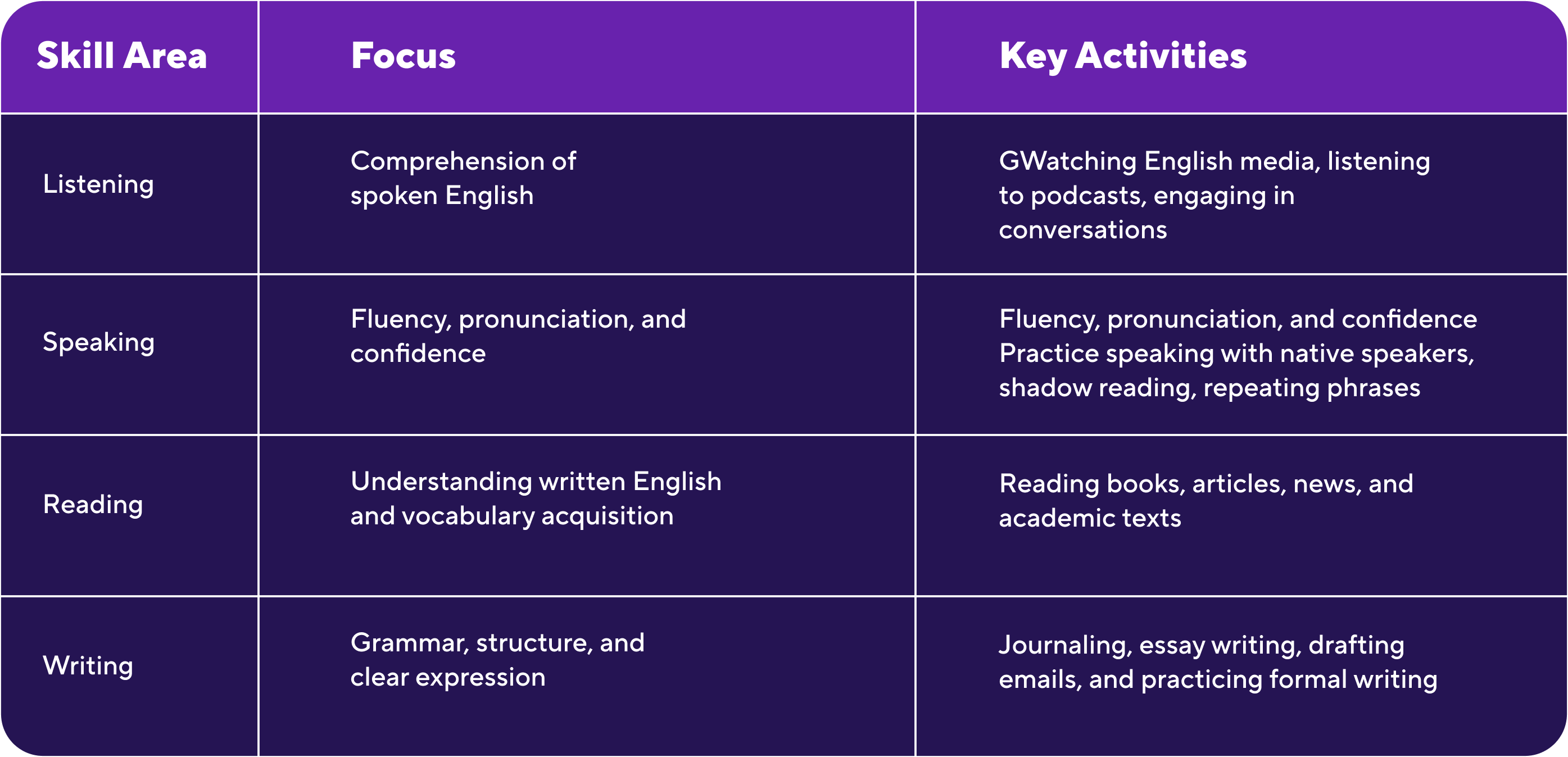
The most effective approach involves a balanced effort across all four core skill areas. Neglecting one area can create a weakness that hinders overall fluency.
To boost your speaking confidence, start with learning and how to use them in daily conversations.
To make the process manageable and effective, it’s best to break down how to learn English step by step into smaller, focused actions. This systematic approach applies to all learners, whether you are targeting general fluency or preparing to teach English as a second language.
Technology provides invaluable resources for beginners starting their journey. The best English learning app for beginners often includes interactive lessons, gamified learning, and repetition to build a solid foundation. For adults, the best English learning app for adults often includes more structured lessons, real-world conversational practice, and tools to track vocabulary and grammar progress.
Some popular features to look for in apps include:
Choosing the right study methods can significantly accelerate your progress. Here are proven strategies for effective learning:
Beyond apps and structured classes, consider these resources:
Learning any language to a high level of proficiency takes time. While you can certainly make significant progress in three months, achieving true fluency—the ability to speak, read, and write naturally and effortlessly—is generally not possible for a complete beginner in such a short timeframe.
However, in 3 months you can:
Rapid progress depends heavily on the intensity of your study. Full-time, immersive study in an English-speaking country will yield much better results than an hour a week of casual learning.

Is English hard to learn for non native speakers? The answer largely depends on your native language.
However, all languages require dedication. Challenges like irregular verbs, phrasal verbs, and subtle pronunciation differences exist for every learner. The most important factor is motivation and consistency, not the starting language.

What is the difference between ESL and ESOL?
ESL (English as a Second Language) is a common term, but ESOL (English for Speakers of Other Languages) is often preferred as a more inclusive term. It acknowledges that for many learners, English is their third, fourth, or an additional language, not necessarily their "second." Both refer to instruction designed for non-native English speakers.
What is the best way to learn English as a Second Language?
The best way is a comprehensive approach that combines formal instruction (classes or structured courses) with daily immersion. Focus equally on all four skills: Listening, Speaking, Reading, and Writing. Consistency is key, even if it's just 20 minutes every day.
Can I learn English in 3 months?
While you can gain a strong foundation and manage basic conversations in 3 months with intensive study, achieving true fluency typically takes longer. Fluency is a long-term goal that requires continuous practice and exposure.
What is the closest language to English?
The closest language to English is Scots, which is sometimes considered a separate language and sometimes a dialect of English. After that, the closest widely-spoken major language is Frisian (spoken in the Netherlands and Germany), followed by other West Germanic languages like Dutch and German. Find out more about foreign words English needs but doesn’t have!


"Love my fun language learning and practice with daily Drops sessions, and monthly Challenges to participate in, and quiz mode to test contextual learning - brilliant! So much thought, consideration and inclusivity has gone into the design and function of this app, I can't praise it highly enough."
"Great little learning app! I've learned at least 5-10 new words in Spanish in my first 5 minutes. Easy to pick up and thorough."
"Great language learning app! It helps you get daily words done in a short amount of time. I would highly recommend using drops to learn whatever language you want to learn."
"What an amazing app! I’ve tried several apps for language learning and I cannot recommend Drops enough. I don’t know how a short Drops session can teach me as much as 1 hour+ of focused use of other apps, it’s like magic."
"Amazing language learning tool. Excellent app for increasing vocabulary in your foreign language of choice. Useful for beginner, intermediate, and advanced learners. The repetition of the words makes them much easier to remember, and without the hassle of making your own flash cards. I have used Drops for two years now and have seen great results."
"Very engaging way of learning Yoruba in a stimulating way. Will be using to learn myself and to teach my child!"
"Less than a week in but using this alone with the popular one babbel working on German. When using just one app I got bored, babbel is not as fun. So using both at once actually let's my adhd do its thing but I still focused since I can switch easily between both apps and work in different areas. Also I like the quick little sessions makes me feel like I actually did something."
"So engaging. I speak Spanish well, but often forget words in conversation that I know I should know. This game is fun and quickly brings back vocabulary I may have put in the back of my brain after not using it for awhile. Case in point: I spent 11 years in construction, then went back to teaching in English and/or Spanish depending on the teacher/student"
"Amazing app"
"I have been desperate to find an app that really helps me learn Japanese and this is the best by far"
"I like that you can switch between different subjects and topics constantly and it’s really easy to learn a lot of vocabulary very quickly! This works perfect for me because I can learn a lot of words but then practice sentence structure with my grandmother whose from Croatia"
"Fantastic app great opportunity to learn languages on your spare time. Drops makes it easy to learn and retain words to formulate sentences."
"Best of the best. Awesome app in every sense"
"This app us the best and how I am doing Learning Ukraine is Helping me alot tnx"
"Definitely recommend! I'm using this to learn mandarin 10/10"
"Fun and interactive. Great for repetition!"
"Very engaging way of learning Yoruba in a stimulating way. Will be using to learn myself and to teach my child!"
"Great little learning app! I've learned at least 5-10 new words in Spanish in my first 5 minutes. Easy to pick up and thorough."
"I have been desperate to find an app that really helps me learn Japanese and this is the best by far"
"I like that you can switch between different subjects and topics constantly and it’s really easy to learn a lot of vocabulary very quickly! This works perfect for me because I can learn a lot of words but then practice sentence structure with my grandmother whose from Croatia"
"Fantastic app great opportunity to learn languages on your spare time. Drops makes it easy to learn and retain words to formulate sentences."
"What an amazing app! I’ve tried several apps for language learning and I cannot recommend Drops enough. I don’t know how a short Drops session can teach me as much as 1 hour+ of focused use of other apps, it’s like magic."
"Love my fun language learning and practice with daily Drops sessions, and monthly Challenges to participate in, and quiz mode to test contextual learning - brilliant! So much thought, consideration and inclusivity has gone into the design and function of this app, I can't praise it highly enough."
"Definitely recommend! I'm using this to learn mandarin 10/10"
"This app us the best and how I am doing Learning Ukraine is Helping me alot tnx"
"Less than a week in but using this alone with the popular one babbel working on German. When using just one app I got bored, babbel is not as fun. So using both at once actually let's my adhd do its thing but I still focused since I can switch easily between both apps and work in different areas. Also I like the quick little sessions makes me feel like I actually did something."


